Compliant E-Cigarette Disposal for Arizona Businesses
A practical 2026 guide for Arizona retailers, vape shops, smoke lounges, and other businesses that collect, handle, or discard e-cigarettes, pods, nicotine e-liquid, and lithium-ion batteries.
Why Business Vape Disposal Requires Hazardous-Waste Management
EPA states that e-cigarettes contain nicotine and lithium batteries, making them hazardous waste under the Resource Conservation and Recovery Act. For a business, the important questions become how much hazardous waste the site generates in a calendar month, how the material is stored, and who is authorized to receive it.
This guide explains what is inside disposable vapes, why nicotine and lithium batteries are counted differently, how EPA generator categories work, what published storage guidance says, where universal-waste rules may apply, how ADEQ administers the program in Arizona, and what to ask a collection provider before signing up.
Are you an individual rather than a business? Read Cloud Cycle’s consumer disposal guide instead. EPA publishes separate guidance for households and individuals.
This Article Is General Information, Not Legal Advice
Requirements vary based on the waste streams at your site, monthly generated quantities, generator category, whether your operation falls under other specialized hazardous-waste rules, and additional site-specific circumstances.
Your Waste Determination
Your business is responsible for determining whether the material it generates is hazardous waste.
Your Generator Category
Applicable requirements depend on all hazardous waste generated at the site during the calendar month.
Your Site-Specific Duties
Verify what applies with EPA, ADEQ, or a qualified environmental compliance professional.
Why Business Vape Disposal Is Different From Consumer Disposal
The difference is not the device. It is volume, accumulation, and accountability. A consumer may discard one device occasionally. A business can generate, accept, and store hundreds of devices in a month as part of its operation.
Waste Determination
A business that generates hazardous waste must determine what it has and which management rules apply.
Monthly Quantity
Generator category is based on the total hazardous waste generated on site in a calendar month, not just the vape devices.
On-Site Accumulation
Customer drop-off bins bring additional discarded material onto the business site where it sits and accumulates.
Documentation
Depending on category, a business may need records, manifests, pre-transport procedures, and evidence that material went to an authorized recipient.
Disposable Vapes Combine Multiple Waste Streams
A disposable vape is not one simple material. EPA identifies two hazards in particular: nicotine and the lithium battery.
| Component | Why It Matters | Management Consideration |
|---|---|---|
| Nicotine e-liquid, pods, cartridges, vials | EPA identifies nicotine e-liquid as an acute hazardous waste with RCRA code P075. | Acute hazardous waste uses a much lower generator threshold than non-acute waste. EPA says not to pour e-liquid down the drain or rinse it out of devices. |
| Lithium battery | EPA states lithium batteries can catch fire, especially when damaged, and that discarded batteries would often be considered ignitable and reactive hazardous waste. | Short-circuit prevention is the core issue. EPA recommends individual sealed bagging or taping terminals as an alternative. |
| Intact e-cigarette device | The complete device carries both nicotine and battery hazards at the same time. | EPA directs schools and small businesses to place each individual e-cigarette in its own clear sealed plastic bag. |
| Plastic housing, board, coil, wick, contacts | These make up much of the device weight but are not the hazardous fraction used for generator-category counting. | They still require a downstream handling plan after collection. |
For additional battery-fire context, see EPA lithium-ion battery recycling guidance.
The counting point many businesses miss: the hazardous fraction—not the visual size or total bin weight—is what matters for generator-category analysis.
Why Nicotine Changes the Hazardous-Waste Picture
Many people assume the battery is the most important regulated component. For retailers, nicotine can be even more consequential because acute hazardous waste has a much lower threshold.
EPA’s guidance for schools and small businesses explains that non-acute and acute hazardous waste are counted separately.
Nicotine Exposure Is Also a Staff-Safety Issue
- EPA advises wearing chemical-resistant gloves such as latex or nitrile where possible.
- Nicotine can be absorbed through skin.
- Employees should not be instructed to dismantle embedded batteries from devices.
How Hazardous-Waste Generator Categories Work
EPA established three generator categories under RCRA. Review the official EPA hazardous-waste generator categories guidance when determining how the thresholds apply.
| Category | Non-Acute Hazardous Waste per Calendar Month | Acute Hazardous Waste per Calendar Month |
|---|---|---|
| VSQG | 100 kg (220 lb) or less | 1 kg (2.2 lb) or less |
| SQG | More than 100 kg and less than 1,000 kg | 1 kg (2.2 lb) or less; more than 1 kg places the generator in LQG |
| LQG | 1,000 kg (2,200 lb) or more | More than 1 kg (2.2 lb) |
The practical takeaway is not a device count. It is a process: know what you are holding, track the acute fraction separately, and move material off site on a predictable schedule rather than letting a back-room bin become the plan.Cloud CycleOn-Site Accumulation
Keeping Devices On Site Does Not Automatically Change Your Category—But Accumulation Still Matters
EPA guidance notes that even a school or business generating less than one kilogram of acute hazardous waste in a calendar month could become an LQG if it accumulates more than one kilogram of acute hazardous waste on site. EPA therefore recommends sending collected e-cigarettes off site on a regular basis.
EPA Example: Lithium Batteries
EPA gives an illustrative estimate that roughly 2,000 18650-type lithium-ion batteries would exceed 100 kg of non-acute hazardous waste.
EPA Example: Nicotine E-Liquid
EPA also publishes product-specific examples for reaching one kilogram of acute nicotine waste. These are illustrations based on stated product volumes—not universal device thresholds.
How to Store Collected Vape Devices Safely
Bag Intact Devices Individually
EPA says to place each individual e-cigarette in its own clear, sealed plastic bag to reduce short-circuit risk.
Bag Loose Lithium Batteries Individually
Loose lithium batteries should also be placed in separate clear sealed plastic bags.
Separate Nicotine Liquid Containers
Nicotine e-liquid vials, cartridges, and pods should be placed in a clear sealed plastic bag. EPA notes multiple items of this type can be combined in the same bag.
Use Terminal Taping as an Alternative
EPA lists taping exposed battery terminals as an alternative short-circuit-prevention method.
Avoid These Handling Mistakes
- Do not put e-cigarettes or e-cigarette components in trash or recycling bins.
- Do not put nicotine e-liquids down the drain.
- Do not rinse or wash e-liquid out of devices.
- Do not bring e-cigarettes to DEA Take-Back Days.
- Do not have employees dismantle damaged or swollen embedded batteries.
Where Universal Waste Fits—and Where It Does Not
The phrase “vapes are universal waste” is too broad. EPA’s universal waste regulations cover specific categories including batteries. A complete e-cigarette that still contains nicotine e-liquid is not the same thing as a loose battery.
| Material | Accurate Framing |
|---|---|
| Complete e-cigarette with nicotine e-liquid | Carries both an acute hazardous-waste component and a battery; manage it based on the applicable generator and waste-stream requirements. |
| Nicotine e-liquid, pods, cartridges, vials | EPA identifies nicotine e-liquid as acute hazardous waste P075. It is not a universal-waste category. |
| Loose lithium batteries | Batteries are one of the federal universal-waste categories where the regulatory conditions are satisfied. |
| Plastic housings and non-hazardous components | Not part of the hazardous fraction for generator-category counting, but they still need a downstream material-management plan. |
What Arizona Businesses Should Know About ADEQ
The Arizona Department of Environmental Quality hazardous-waste program administers and implements the hazardous-waste framework in Arizona.
Waste determination: ADEQ states the generator is responsible for determining whether its solid waste is hazardous.
EPA ID numbers: ADEQ manages EPA identification-number processes through myDEQ.
Transporters: ADEQ states hazardous-waste transporters must obtain an EPA ID.
Universal-waste time limits: ADEQ identifies storage beyond the one-year universal-waste limit as a permitting issue.
Generator exemptions: generators complying with the applicable conditions in 40 CFR 262 may operate without a hazardous-waste permit.
Building a Vape-Waste Collection Workflow
Identify
Separate intact devices, loose batteries, e-liquid containers, and damaged units.
Store
Use EPA-aligned short-circuit and containment practices.
Track
Record what accumulates and keep acute material separate for counting purposes.
Schedule
Use recurring pickups rather than waiting for a container to become full.
Hand Off
Release material only to a party or facility set up to receive it.
Documentation matters: retain pickup records, quantities, dates, and any manifest or shipping paperwork that applies to your generator category.
Questions to Ask a Vape-Waste Collection Provider
| Question to Ask | Why It Matters | What the Business Should Verify |
|---|---|---|
| What materials do you accept? | Intact devices, loose batteries, and e-liquid containers are not interchangeable streams. | Get the accepted and refused material list in writing. |
| How should devices be stored before pickup? | Storage guidance should align with published EPA practice. | Check that instructions address individual bagging or terminal taping. |
| How often are pickups available? | Acute-waste accumulation is the pressure point. | Make sure cadence matches your actual monthly volume. |
| Who transports the material? | ADEQ states hazardous-waste transporters must obtain an EPA ID. | Know who physically moves it and under what authorization. |
| Where does the material go after pickup? | The downstream destination determines what actually happens to the waste. | Ask for a named downstream destination or partner. |
| What documentation is provided? | You need a record of what left, when, and how much. | Distinguish company-issued paperwork from regulatory documents such as manifests. |
| How are damaged or swollen batteries handled? | Damaged lithium batteries present higher fire risk. | Ask for a specific damaged-device procedure. |
| What happens downstream? | Recovery claims vary across the industry. | Ask what is recovered and what documentation supports that claim. |
No collection provider can promise that using its service automatically makes a business compliant. A good provider can make the collection, storage handoff, pickup cadence, and documentation process more reliable and easier to manage.Cloud CycleConsumer vs. Business
Business Disposal Has More Moving Parts
| Factor | Individual Consumer | Arizona Business |
|---|---|---|
| Volume | One or a few devices occasionally | Ongoing stream that may reach hundreds per month |
| Waste Determination | Not the business-generator framework | Generator is responsible for determining whether waste is hazardous |
| Generator Category | Not applicable | Determined by hazardous waste generated on site per calendar month |
| Storage | Keep safe until drop-off | Bagging or terminal protection, defined storage area, trained staff |
| Handoff | Collection point or take-back option | Authorized person or facility appropriate for the waste stream |
| Records | Usually none | Pickup and quantity records, plus category-specific paperwork where required |
How Cloud Cycle’s Collection Program Works
Cloud Cycle, Arizona vape and battery collection, is built for businesses rather than walk-in consumer disposal. The service addresses a practical operating problem: used devices accumulate on site, and the business needs them to leave on a predictable schedule with records attached.
Collection Bins
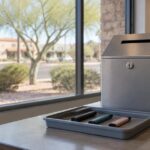
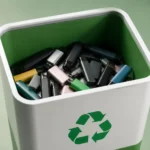
Bins are placed at participating businesses for discarded vape devices and lithium-ion batteries.
Recurring Pickups
Scheduled pickups help reduce uncontrolled back-room accumulation.
Arizona Operations
The program is designed for vape shops, smoke lounges, retailers, and other Arizona businesses.
Collection Documentation
Cloud Cycle provides company-issued collection records for participating businesses.
Businesses can review the Pilot Program to learn about the business vape collection program and current participation process.
For additional company background, read the story of Cloud Cycle.
Frequently Asked Questions
Can a business throw disposable vapes in the trash?
EPA guidance for schools and small businesses says e-cigarettes and e-cigarette components should not be placed in trash or recycling bins. What your business must do instead depends on your generator category and actual waste streams.
Are disposable vapes hazardous waste?
EPA states e-cigarettes contain nicotine and lithium batteries, bringing them within the RCRA hazardous-waste framework. Nicotine e-liquid is identified as acute hazardous waste P075, while discarded lithium batteries may also qualify as ignitable and reactive hazardous waste.
Are vape batteries universal waste?
Batteries are one of the federal universal-waste categories where the applicable regulatory conditions are met. A complete e-cigarette containing nicotine is not automatically the same waste stream as a loose battery.
How should a business store discarded vapes?
EPA guidance says to individually bag intact e-cigarettes and loose lithium batteries in clear sealed plastic bags. It also identifies taped battery terminals as an alternative short-circuit-prevention method.
Does a vape shop need an EPA ID number?
It depends on the site’s generator category and activities. ADEQ manages EPA identification numbers through myDEQ, and businesses should confirm their specific requirement with ADEQ.
How often should discarded vapes be collected?
EPA recommends that businesses send collected e-cigarettes off site regularly to avoid excessive acute hazardous-waste accumulation. There is no universal pickup frequency; the schedule should reflect actual site volume.
Can vape shops collect used devices from customers?
Collection programs exist, but accepting customer devices brings additional discarded material onto the site. The business should plan storage, tracking, pickup frequency, and the authorized handoff path before launching a drop-off program.
What documentation should a business keep?
Keep records of what was collected, in what quantity, on what date, and who received it. Additional recordkeeping depends on generator category and the specific hazardous-waste requirements that apply.
Talk to Cloud Cycle About a Recurring Collection Program
If your shop is holding discarded devices with no scheduled way for them to leave, the first operational problem to solve is predictable collection. Cloud Cycle’s Pilot Program is designed for Arizona businesses that want collection bins, recurring pickups, and company-issued documentation of collected material.
About Cloud Cycle
Cloud Cycle is an Arizona vape waste and lithium-ion battery collection service working with businesses that need a more structured process for collection, recurring pickup, downstream handoff, and internal documentation.